
April 17, 2026
How to Read Your Dog's Body Language When They Are in Pain
Dogs rarely vocalize pain the way we expect them to. The signals are almost always physical and postural. Here is what to look for.
How to Read Your Dog's Body Language When They Are in Pain
Most people expect a dog in pain to whimper, cry, or limp dramatically. That is not usually how it works.
Dogs are extraordinarily good at masking discomfort. It is not something they choose to do. It is instinctive, carried forward from thousands of years of evolution in environments where showing vulnerability had consequences. The result is that by the time a dog is vocalizing pain clearly, they are often well past the early stages of whatever is causing it.
The signals that come earlier are physical and postural. They are subtle. And once you know what to look for, they become much harder to miss.
Postural Changes
The way a dog holds their body when they are uncomfortable is one of the most reliable indicators available. The challenge is that postural changes happen gradually and owners adapt to them without realizing the baseline has shifted.
A hunched or tucked posture, where the back is slightly rounded and the abdomen appears drawn up, often indicates abdominal discomfort. A dog standing with their front legs spread wider than usual and their head lowered may be trying to shift weight away from their hindquarters. A dog that repeatedly stretches into a bow position, front legs extended and rear end up, can be trying to relieve abdominal pressure.
These are not dramatic poses. They are small departures from how your dog normally stands and moves. That is why knowing your dog's normal posture matters as much as knowing what abnormal looks like.
Facial Tension
Dogs in pain show it in their face, and most owners do not know how to read it.
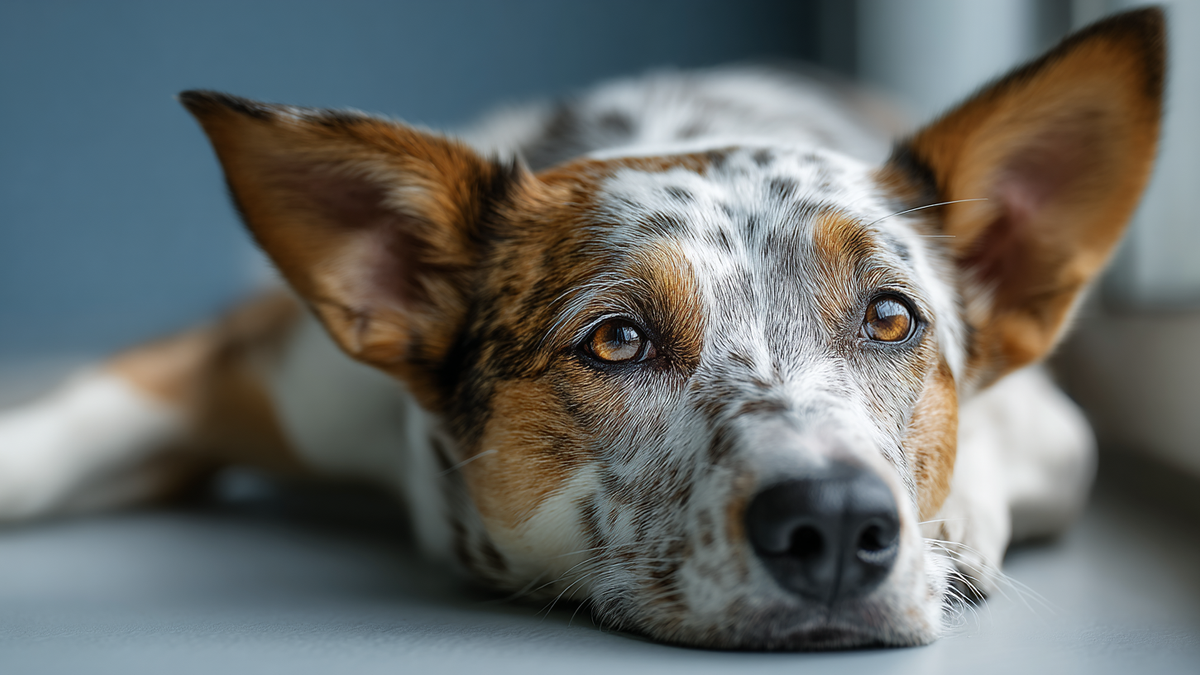
The signals to look for are tension around the eyes, a furrowed brow, ears pulled back or held flatter than usual, and a tightness around the muzzle. The eyes may appear partially closed or squinting even in normal light. The overall expression tends to look strained rather than relaxed.
A relaxed dog has soft eyes, loose facial muscles, and ears in their natural resting position. Compare that mental image against what you see when you look at your dog closely and you will start to notice the difference.
Researchers studying animal pain have developed formal scoring systems that rely heavily on facial expression. The same signals used in veterinary pain assessment are visible to owners who know what they are looking for.
Guarding Behavior
Guarding is when a dog protects a specific area of their body from being touched or bumped. It shows up in a few different ways.
A dog may flinch or pull away when you touch a certain area that they would normally be indifferent to. They may shift position to move that area away from your hand. They may become tense or hold their breath when you approach a sensitive spot. In more pronounced cases they may vocalize or snap, which as noted earlier is a pain response rather than an aggression response in a dog with no prior history of that behavior.
The specificity of guarding is useful. A dog that is consistently sensitive in the same area is telling you something localized. That information is worth documenting and bringing to your vet.
Breathing and Panting Changes
Shallow or faster than normal breathing at rest is a pain signal that gets overlooked because it is easy to attribute to temperature or exertion.
Panting in a cool environment with no recent exercise is worth paying attention to. Pain activates the stress response, which drives panting as a physiological reaction. A dog that is panting heavily while lying still, or breathing shallowly in a way that looks effortful, may be in more discomfort than their stillness suggests.
Changes in Movement Transitions
How a dog moves between positions is often more informative than how they move when they are already up and walking.
Watch how your dog gets up from lying down. Do they rock forward before rising? Do they use their front legs to push up rather than rising smoothly? Do they pause partway through the transition? Watch how they lie down. Do they lower themselves carefully and slowly rather than dropping comfortably? Do they circle repeatedly before settling?
These transition movements place specific demands on specific joints and muscle groups. Difficulty in transitions often points to where the discomfort is located even before a formal examination.
Repetitive Behaviors
Repetitive licking, chewing, or attention to a specific body part is a self-soothing behavior that often indicates localized discomfort. A dog that repeatedly returns to the same spot on their leg, hip, or paw is telling you that area needs attention even if there is nothing visibly wrong on the surface.
Similarly, a dog that repeatedly repositions, cannot seem to get comfortable, or keeps shifting weight from foot to foot when standing may be managing discomfort that does not yet have an obvious external explanation.
Putting It Together
No single signal on this list is definitive on its own. What matters is pattern and context. A dog that is slightly quieter than usual on one afternoon is probably fine. A dog that has a tense facial expression, is slow to rise in the morning, and has been licking the same spot on their hip for two weeks is communicating something consistent enough to warrant a vet conversation.
Your role is observation and documentation. Write down what you notice, when it started, and whether it is getting better or worse. That information transforms a vague concern into a useful clinical picture.
How CANIQO Helps
Posture and visible physical signals are part of what CANIQO analyzes during a health scan. Regular scans build a record of how your dog looks over time so that when something changes, you have documented evidence of the shift rather than a feeling that something seems different.
Start a free health scan at caniqo.com. See what your dog can't tell you.