
May 30, 2026
What It Means When Your Dog Suddenly Starts Hiding
A dog that has started disappearing under the bed or retreating to unusual spots is almost always communicating something. Here is what to look for and when to act.
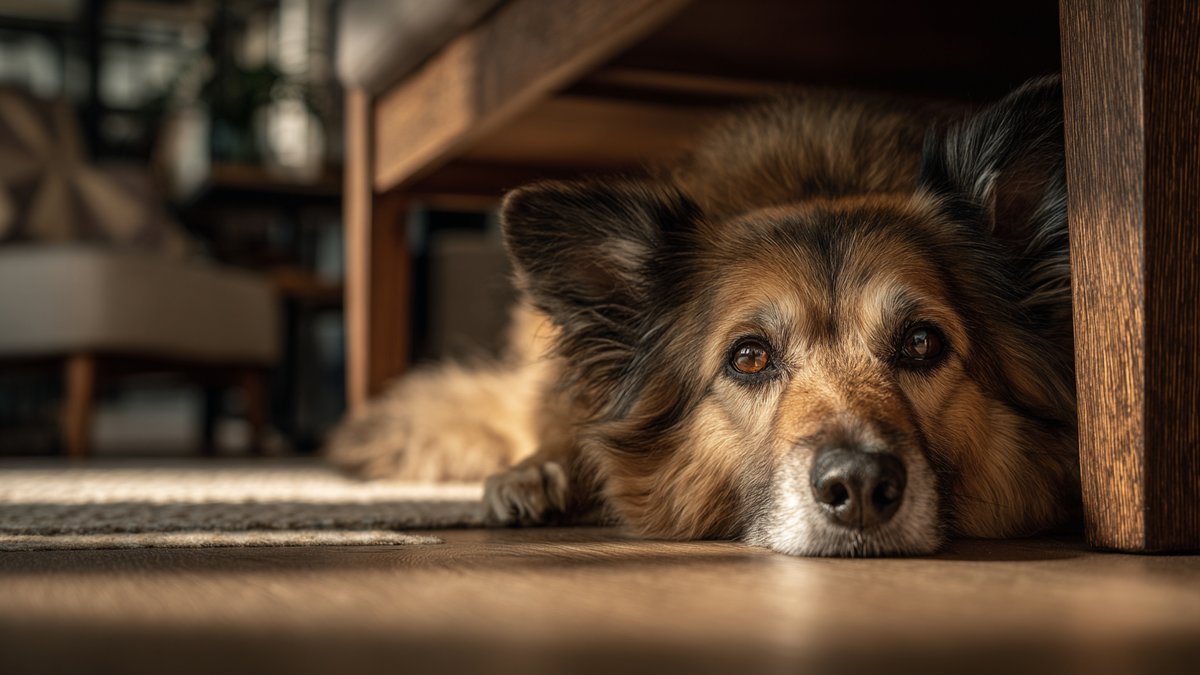
Some behavior changes in dogs are loud. A dog that starts barking more, jumping more, or demanding more attention is hard to miss. Hiding is the opposite. A dog that has started disappearing for an hour at a time, retreating under furniture, or settling in spots they never used to use is showing one of the quietest behavioral signals there is, and it is often one of the most meaningful.
Hiding is not a personality quirk. It is not a sign that your dog is mad at you. It is a behavior with a small number of likely causes, and almost all of them are worth taking seriously.
Why Hiding Is a Strong Signal
In the wild, dogs that feel vulnerable seek cover. Domesticated dogs have not lost this instinct. When something feels off, whether physical or emotional, dogs frequently retreat to a small, enclosed, low-traffic spot where they can be alone. Under a bed. Behind a couch. In a closet. In a corner of the basement. The specific spot is less important than the pattern.
The reason this is such a useful signal is that it is rarely random. Dogs do not start hiding for no reason, and they do not generally hide when they feel safe and well. A dog that was previously social, present in the household, and comfortable in their usual spots, and is suddenly choosing isolation, is communicating something.
The other reason it is worth paying attention to is that hiding is often the earliest visible behavior change before other symptoms emerge. By the time other things appear, like reduced appetite or changes in mobility, the hiding has usually been going on for several days already.
The Most Common Cause
Physical discomfort is the leading reason for new hiding behavior in dogs. Pain, nausea, fever, or general feeling-unwell sensations all trigger the retreat instinct. A dog with a developing illness will often start spending more time alone before any other symptom becomes obvious. The hiding is the first thing, not the last.
The pattern is distinctive. A dog that is hiding because of physical discomfort usually does not want company once they have retreated. They may resist being coaxed out. They may move to a new spot if their first one is disturbed. They are not seeking attention. They are seeking distance.
This is the opposite of clinginess, which is also a discomfort signal but often presents in dogs that find proximity to their person reassuring. Hiding tends to show up in dogs whose temperament is to handle stress alone, and in dogs who are feeling badly enough that even their person's presence feels like too much stimulation.
Fever in particular often produces hiding. A dog running even a mildly elevated temperature frequently seeks out a cool, dark spot and stays there. If your dog is hiding and feels warm to the touch, especially around the ears and belly, that is worth a same-day vet call.
The Sensory Cause
Dogs that are starting to lose hearing or vision sometimes begin hiding as those changes progress. The world has become more confusing and less predictable, and retreating to a familiar enclosed space reduces the volume of sensory input they have to process.
This is often missed because the underlying sensory change is gradual and the hiding seems to come out of nowhere. The pattern usually involves an older dog who has slowly become less responsive to sounds or visual cues, and who has started seeking out small, contained spaces during times of day that used to be active.
The Cognitive Cause
For senior dogs, hiding can be one of the earlier signs of canine cognitive dysfunction. A dog with early cognitive change may start ending up in unusual places, sometimes without clearly choosing to be there. They might get stuck in a corner or end up behind furniture they used to navigate around easily. The behavior can look like hiding but is sometimes more accurately described as disorientation.
The distinguishing feature is whether the dog seems to be deliberately seeking the spot or seems confused about how they got there. A dog who walks purposefully to a hiding spot and settles is making a choice. A dog who ends up wedged in an awkward space and stands there blankly is showing something different, and it warrants a different kind of attention.
The Emotional Cause
Sometimes hiding is anxiety, not illness. A recent stressor in the household. A new pet. A new baby. Construction. Visitors who made the dog uncomfortable. Even a single startling event, like a loud crash or a fight between people in the household, can produce days of hiding behavior afterward.
Storm anxiety and noise sensitivity are common, and they often get worse with age. A dog who used to handle thunder fine and now hides for hours after the slightest rumble is showing a real shift, and it is worth addressing because untreated noise sensitivity tends to escalate.
If the hiding is clearly time-locked to a specific trigger, like only during fireworks or only when a particular visitor is in the house, the cause is usually anxiety rather than illness. If the hiding is happening at random times with no clear trigger, the cause is more likely physical.
What to Look For
Pay attention to a few specifics. How often is your dog hiding. Where are they choosing to go. How do they respond when you find them. Are they willing to come out, or do they resist. Are they still eating, drinking, and going outside on their normal schedule. Is their posture different when they emerge.
A dog that hides for an hour, comes out for dinner, eats normally, and returns to their usual evening routine is showing milder behavior than a dog that has been hiding most of the day and is no longer interested in food.
The other thing to track is whether your dog is still showing up for the moments that used to define their day. Greeting you at the door. Asking to go out at the usual time. Settling in their usual spot in the evening. A dog that is hiding but still showing up for the major routines is showing milder concern than a dog whose hiding has displaced their normal patterns entirely.
What Not to Do
Do not force a hiding dog out of their spot. If they are seeking quiet because they feel unwell, dragging them into the open does not help them, and it can damage trust. If they are anxious, forced exposure can make the underlying anxiety worse. Let them stay where they are while you assess.
Do not assume it will pass without paying attention. Hiding that lasts more than 24 to 48 hours is rarely just a mood, and the longer it goes without explanation, the more likely the cause is physical.
Do not punish or scold the behavior. Hiding is not disobedience. It is communication.
When to Act
A dog that has started hiding suddenly, with no obvious environmental trigger, and the behavior has lasted more than a day, is worth a vet call. If the hiding is paired with reduced appetite, lethargy, vomiting, or any visible physical change, the timeline tightens to a same-day call.
If your dog is hiding and seems generally unwilling to interact, or feels warm, or has any obvious discomfort when you handle them gently, that is an urgent visit, not a wait-and-see.
For senior dogs, even mild new hiding behavior is worth bringing up at the next vet appointment, especially if other small changes have been adding up alongside it.
Why This Matters
Dogs spend most of their lives trying to be present with their people. When they start choosing absence, it is almost always a sign that something has shifted. Catching that shift early gives you the best chance of figuring out what is behind it before it escalates into something more obvious.
The dog that disappeared under the bed this week is the same dog that was at your feet last week. The change is the data. The reason is what matters.
Upload a photo at caniqo.com and the AI will analyze visible signals across your dog's posture, eyes, and overall condition. Pair what you see in their behavior with what the analysis can see in the image, and quiet retreat stops being invisible.
See what your dog can't tell you.