
May 18, 2026
Why Your Dog Is Suddenly Restless at Night and What It Usually Means
A dog that used to sleep through the night and now does not is rarely just being annoying. Here is what nighttime restlessness actually signals and when to act.
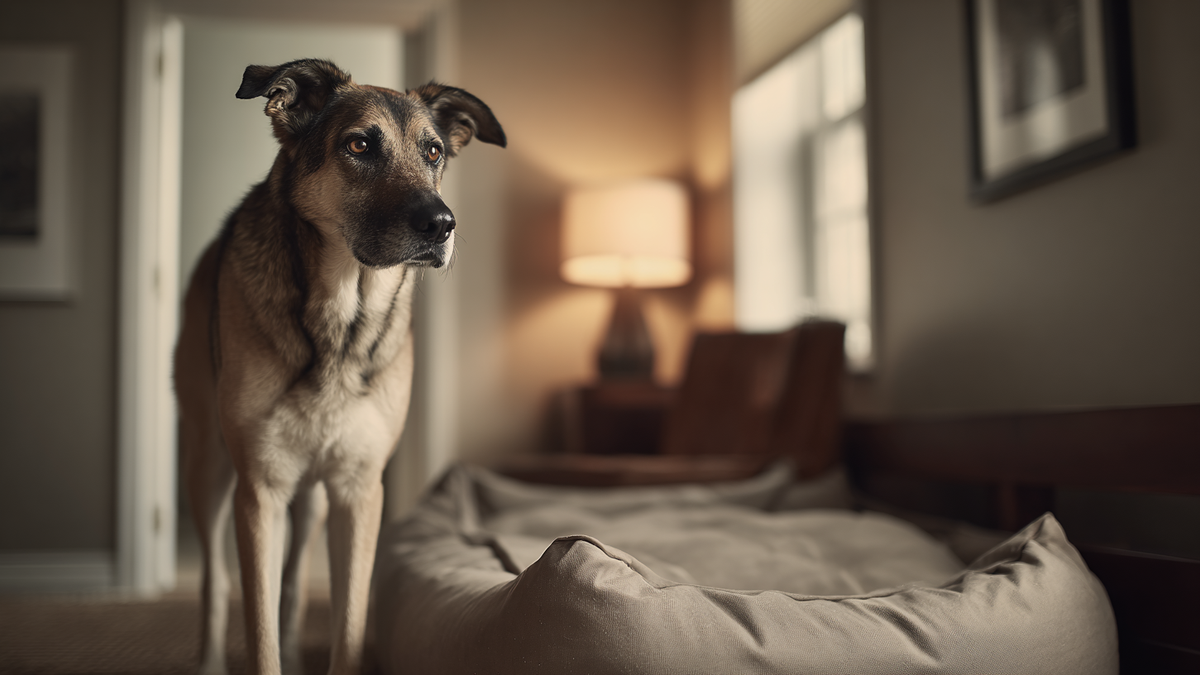
Few things test an owner's patience like a dog that has suddenly started waking up at night. The pacing. The repositioning. The quiet whining at 3 AM. The trip to the water bowl that turns into a full circuit of the house. Most owners eventually chalk it up to the dog being weird, getting older, or going through a phase. That is almost never what is actually happening.
A dog that has consistently slept through the night and suddenly stops is communicating something. The change itself is the data. Identifying what is behind it is usually more straightforward than people assume.
Why Sleep Disruption Is a Strong Signal
Sleep is one of the most stable behaviors in a healthy dog's life. Adult dogs sleep twelve to fourteen hours a day, and most of them establish a consistent overnight pattern within the first year of their life. They settle in the same spot, they sleep through the same hours, and they wake at roughly the same time each morning.
When that pattern breaks, especially in a dog with no recent environmental changes, it is one of the most reliable indicators that something has shifted. Dogs do not voluntarily disrupt their own sleep. If they are up, there is a reason.
The Most Common Cause
Physical discomfort is the leading reason for new nighttime restlessness, and joint pain is the most common form. Dogs with developing arthritis often sleep fine for the first few hours, then wake up stiff once they have been in one position too long. They reposition repeatedly because no position stays comfortable. They get up, stretch, lie back down, get up again ten minutes later.
The pattern is distinctive. A dog with sleep disruption from joint discomfort usually does not pace constantly. They cycle. Settle, shift, get up briefly, resettle. Owners often describe it as the dog not being able to get comfortable. That description is almost always literally correct.
This shows up first in middle-aged large breed dogs but can appear in any dog as they age. It is one of the earliest signs of joint deterioration, often appearing months before any visible limp during the day.
The Second Most Common Cause
Bladder and digestive issues are the second category. A dog that suddenly needs to go out in the middle of the night, when they have not needed to in years, is signaling something. It might be a urinary tract infection. It might be increased water intake from a developing condition like diabetes or kidney disease. It might be early prostate issues in unneutered males. It might be a mild ongoing stomach issue causing late-night nausea or the need to defecate at unusual hours.
The test is whether the dog actually uses the bathroom when they go out. A dog that needs to be let out, urinates immediately, and then settles is communicating a real physical need. A dog that goes out, stands around, and comes back in without doing anything is more likely experiencing general restlessness from another source.
Cognitive Changes in Older Dogs
For senior dogs, especially those over ten, nighttime restlessness is often the first visible sign of canine cognitive dysfunction. This is the dog equivalent of dementia, and the sleep-wake cycle is one of the earliest things it affects.
The pattern looks different than joint discomfort. Cognitive change tends to produce more disoriented behavior. The dog might stand in the middle of a room without seeming to know why they got up. They might stare at walls. They might pace in tight circles or get stuck in corners. They often seem mildly confused, especially right after waking.
This is worth taking seriously and discussing with a vet, because there are real interventions that can slow the progression and improve quality of life when cognitive change is caught early.
Anxiety and Environmental Causes
Sometimes the cause is not physical at all. A new neighbor with a dog that barks late at night. A change in the household routine. A move to a new home. Construction nearby. Even seasonal shifts in light and temperature can affect how dogs sleep, especially in older dogs whose thermoregulation is less efficient than it used to be.
Separation-related anxiety can also produce nighttime restlessness, especially if there has been any change in who is home and when. A dog whose owner started traveling for work, or whose family added a new baby, may start sleeping less soundly even months after the change.
Pain You Cannot See
Less obvious sources of nighttime discomfort include ear infections, which often feel worse at night when the dog is lying down with one ear pressed against the bed. Dental pain follows a similar pattern. Skin irritation, including the early stages of a hot spot, can keep a dog up because the itching is more noticeable when the rest of the environment is quiet.
If your dog is waking up and immediately focusing on a specific part of their body, licking it, scratching it, or shaking their head repeatedly, that body part is the answer to why they are awake.
What to Track
Pay attention to a few specific things. What time does the restlessness start? Is it within the first hour of sleep or several hours in? Does your dog actually do anything when they get up, or do they just stand and reposition? Do they go to the same spot each time? Are they trying to communicate something to you, or do they seem to be working through something on their own?
A dog that wakes up at the same time each night, goes outside, and settles back into sleep is showing a different pattern than a dog that wakes up at random times, paces aimlessly, and cannot resettle. Both are worth addressing, but they point to different underlying causes.
When to Act
A single bad night means nothing. A pattern of disrupted sleep across more than a week is worth a vet conversation. Combined with any daytime change, like reduced appetite, slower walks, or a shift in mood, it becomes more urgent.
For senior dogs, even mild nighttime disorientation is worth bringing up at the next vet visit, even if everything else seems normal. Catching cognitive change early opens up options that are not available later.
For all dogs, if the restlessness is paired with whining, panting at rest, or any visible discomfort, that is a same-week vet call rather than a wait-and-see.
Why It Is Worth Paying Attention
Sleep is the most honest signal a dog gives you. They cannot mask it the way they mask many other forms of discomfort during the day. A dog that is hiding pain while you are watching them will still struggle to sleep through that same pain at night.
If the nights have changed, the dog has changed. Figuring out what changed is almost always solvable, and almost always worth the effort.
Upload a photo at caniqo.com and the AI will analyze visible signals across your dog's posture, eyes, and overall condition. Pair what you see at night with what the analysis can see during the day, and the picture gets clearer.
See what your dog can't tell you.